A home lab where AI stays at home
The governance frameworks published on this site are tested on real hardware. This lab hosts models, data and connected objects at home, behind a single perimeter and under written operating rules.
Data and models never leave the house
A governance project that only runs on slides proves nothing. The lab gives each repository on the Work page a place to run: Arduino boards that sense and act, a network that isolates them, models that run locally and a store that keeps the archives.
Nothing is exposed to the Internet. Document data and models stay on site, and only the connectors to external services leave the perimeter.
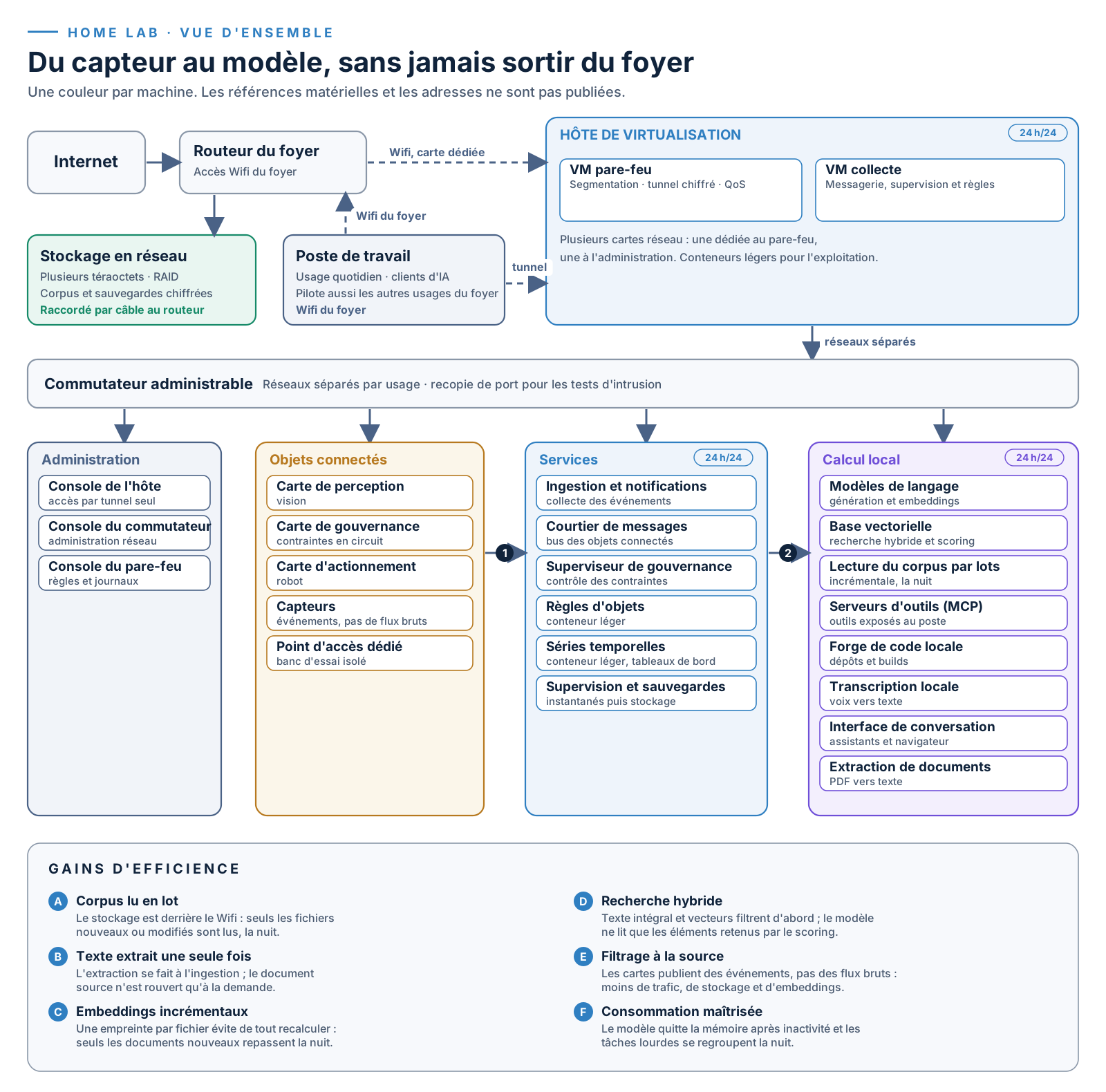
Scroll the diagram sideways to see all of it.
Virtual machines, containers and functions, node by node
Each rectangle is a function, tied to the type of environment that runs it. Numbered arrows are described below the diagram.
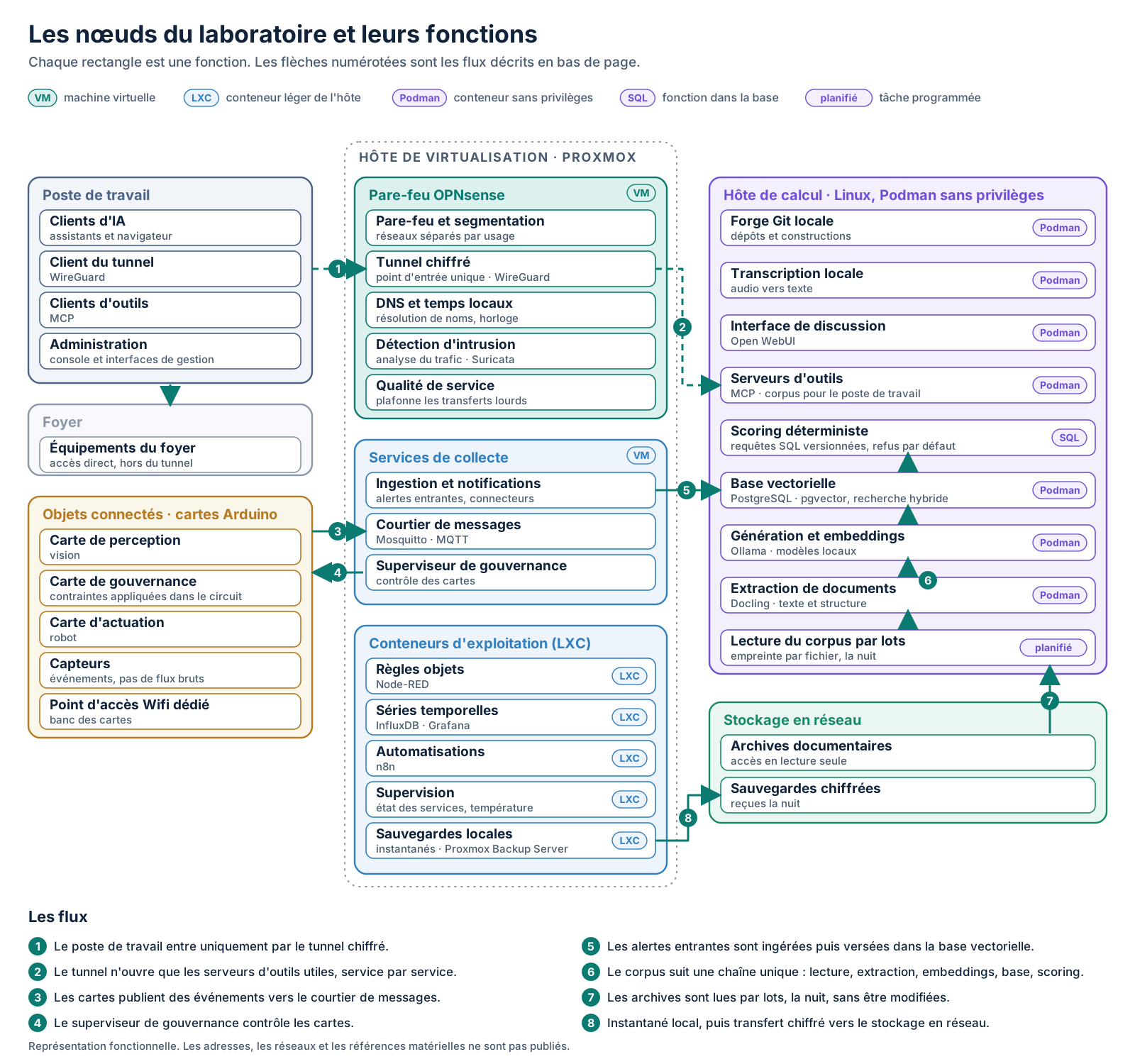
Scroll the diagram sideways to see all of it.
Each layer has a role and a boundary
Connected objects
Arduino boards sense and act. They publish events rather than raw streams, which limits traffic, storage and downstream compute.
Segmented network
A virtualised firewall separates uses into distinct networks: administration, services, compute, objects. The workstation enters the lab only through a single encrypted tunnel.
Local compute
Language models, a vector database and a deterministic scoring function written as queries. Tool servers expose the corpus to the workstation, service by service.
Long-term storage
Document archives live on network storage, read in batches and at night. Backups work in two steps: a local snapshot, then an encrypted transfer.
Four rules the lab applies
"Every access decision rests on a rule, never on a habit."
A single way in. The workstation reaches the lab through an encrypted tunnel, and the tunnel opens only the services it needs. A compromised workstation does not open the whole lab.
No connection starts from the lab toward the household network. Address ranges stay distinct and the firewall blocks by default.
Refusal by default. Scoring answers with a refusal when supporting evidence is missing, following the same logic as the repositories on the Work page.
Automatic recovery. After a power cut, the firewall starts first and services follow in order, with no intervention.
A home lab, with the limits of its scale
It exists to test mechanisms. No production load depends on it.
- One site and no hardware redundancy. A machine failure interrupts service until it is repaired.
- The link to the household network runs over Wi-Fi, with the throughput and latency that implies: heavy transfers happen at night.
- One person operates the whole, with no on-call rota and no service-level agreement.
- No performance figure is published here: measurements belong to the bench described in <code>measurement-harness</code>.
A governance claim is verifiable, or it is worth nothing
The code of each link is public. To discuss this work, write to the author.